A Couple of Posts about AI and the IGF Awards

Hey everyone,
I’ll be honest, I didn’t expect to write another letter so soon after sharing my thoughts on Penguin Colony, but maybe I should’ve been. Because by the time I was writing about that game, which I had played in consideration for this coming year’s Independent Games Festival awards, I was already spending a lot of time thinking about the topic of this post, which is AI in games (and specifically, how to think about awards, attention, and agency in relation to AI in this industry).
To be clear: Penguin Colony was, per its IGF entry text, not made with AI. But other games—including some I not only enjoyed but loved—did use AI in varying ways. These were made by veteran developers, including some that I deeply respect.
These disclosures were surprising, as they hadn’t shared disclosure statements on their Steam pages since, as it has since come out, the disclosure requirements on Steam and other storefronts is different than that of the IGF. And that surprise led to a lot of long, difficult discussion. And that long discussion, across two stages of the IGF awards process, led eventually to this statement. written and signed by 19 of the 50-or-so IGF Jurors:
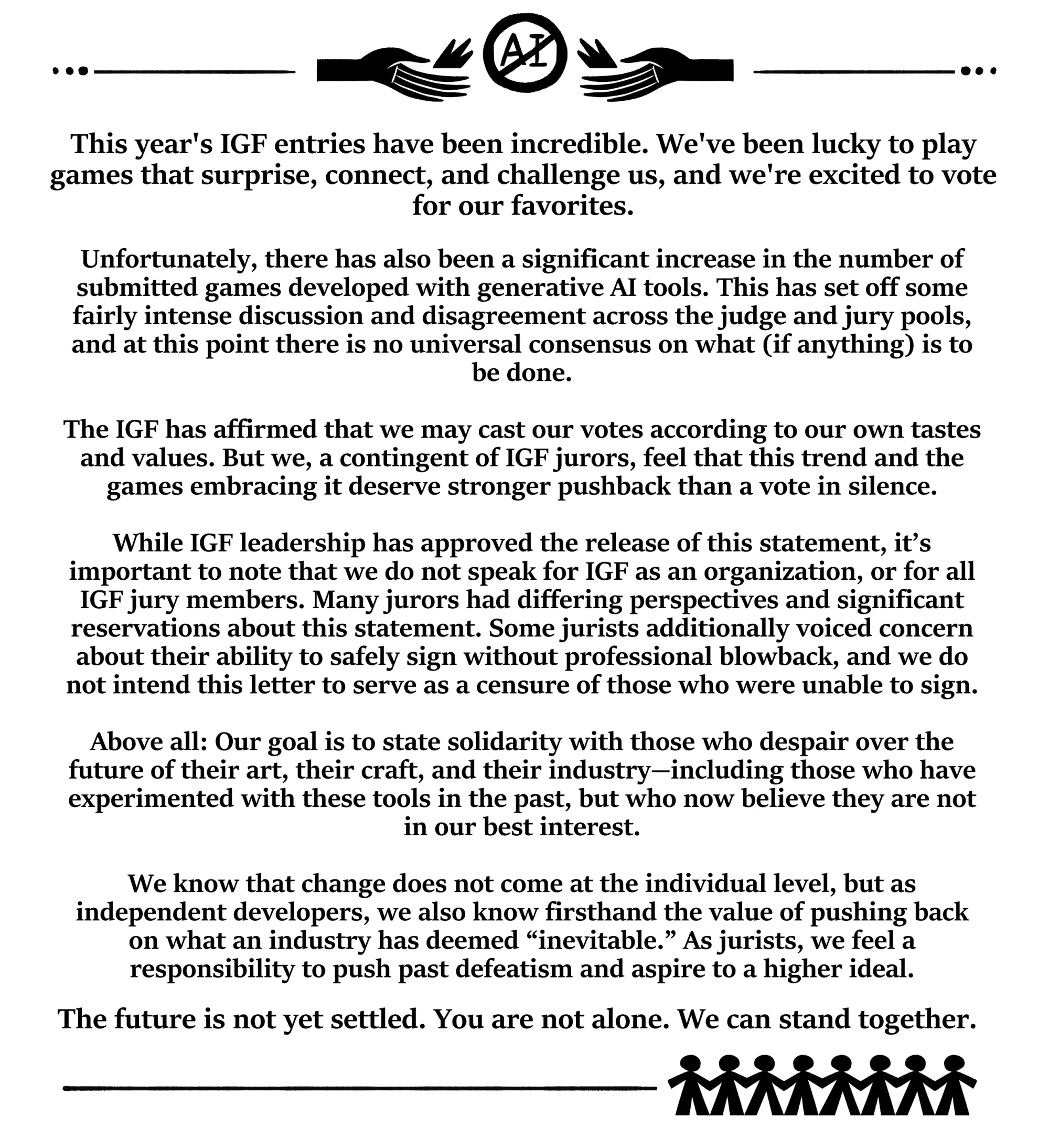
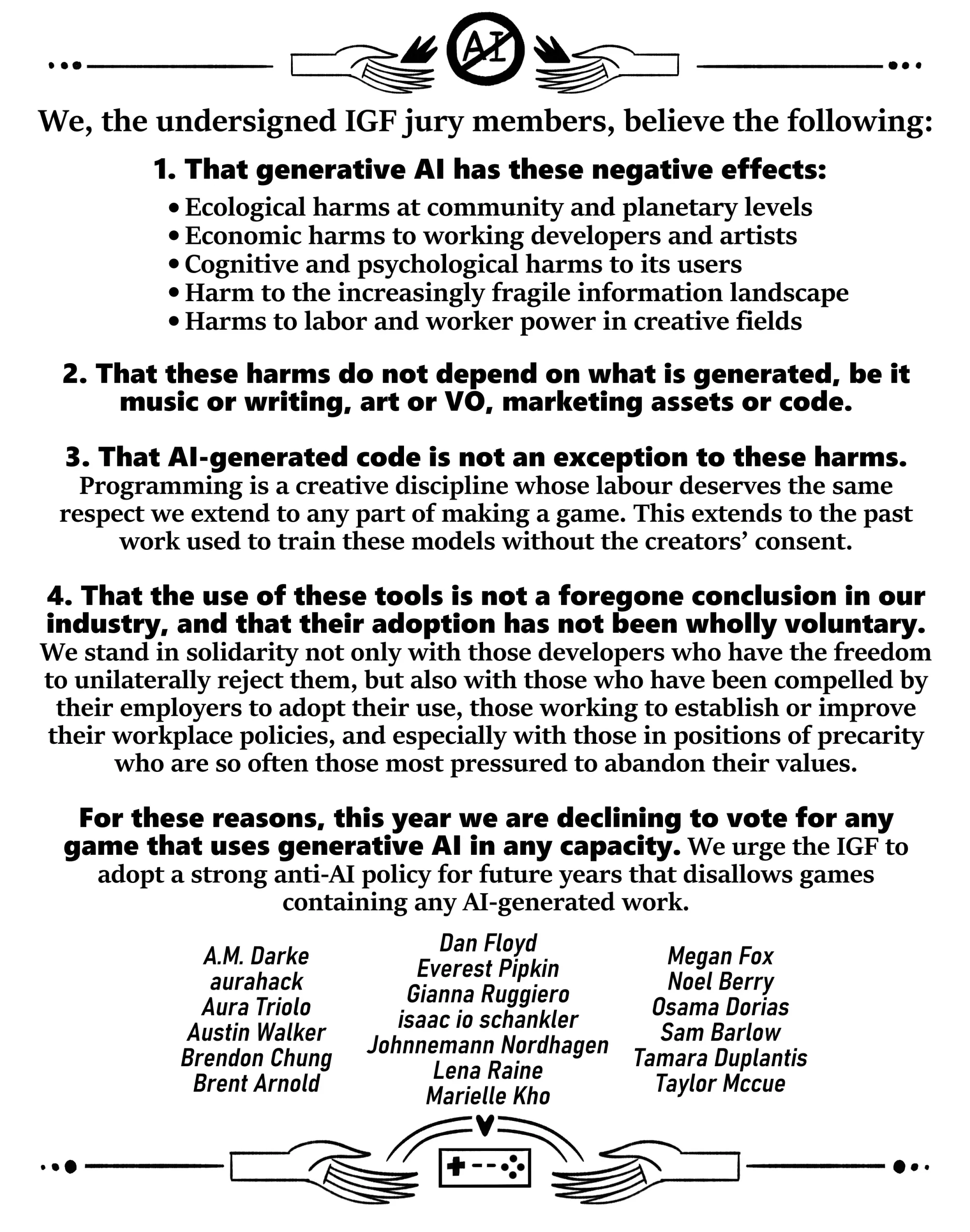
It’s been a day since this went out, and I’ve been seeing a lot of the same conversations play out externally that I saw play out over the last few months. During that period, I shared some thoughts internally about my own position about all of this that some fellow developers found helpful, with a few even asking me to post them publicly. I sort of demured at that request, but after reading some similarly helpful posts from Damon Reece and Hannah Nicklin today, I thought maybe I would let my own words out of their box and into the mix.
First, I want to offer a little context about the IGF Awards process (at least as it’s existed for the past few years that I’ve been a part of it), since I think that’s helpful. If you already know how the IGF works, feel free to search for “Two Posts on AI and the IGF Awards” and jump down to that part of the newsletter.
Context on the Independent Games Festival Awards
The IGF accepts game submissions for about a month in late summer, and each submission has an attached $75 fee, though submissions waivers are available in some cases. (If you’ve ever wondered why an indie game that lots of people love doesn’t show up in the awards, it’s often because it wasn’t submitted. Developers, publishers, please submit your games).
Then, the IGF invites hundreds of game developers, critics, and industry members to join in an initial, one-month round of assessment. These people are called judges, and each is assigned a set of games (about 10, give or take) to rate. Each judge plays those games and decides if they’d like to ‘nominate’ them for one of that year’s award categories. They ideally also discuss their feelings about these games in a comment section (attached to the game’s entry on the IGF backend), and then they move on to games not on their initial list.
After this initial judging round, around 50 jurists are invited in on a per category basis. So, for instance, for the past two years and into this year, I have been a member of the Excellence in Narrative jury, which is made up of (I think) about 7 other members.
Some jurists have been judges in the year they are on the jury, other jurists only come on at this stage. But every jurist gains access to the nomination data from the judging round, and is given a month to play and assess games in the category they’ve been assigned. Each jurists can vote for as many games as they want in their category, but the votes are numbered and weighted. Then, there’s another few weeks after that during which jurists assess and vote for the Seumas McNally Grand Prize.
In my experience, jurists spend a lot of this time talking to each other about not only the games they’re playing, but also the year’s trends, interesting edge cases (like what “counts” as ‘indie,’ since this is not something that the IGF itself gives criteria for), and deeper critical and emotional feelings they’re having about the medium, craft, and industry.
I say all of this because the two things I wrote took place across this process. The first bit I wrote, posted below, appeared in the comments section for House House’s Big Walk, which drew the most conversation I’ve seen a game have in my (admittedly few) years of judging. First it drew lots of comments from people saying ‘don’t ignore this game as friend slop,’ then, once its use of AI became clear, it turned into a larger conversation not only about that game, but about broader positions, hypotheticals, and strategies.
Then, when the jury process began, a dedicated Slack channel for deliberation around this AI popped up, and the conversations broadened even further, eventually leading to the statement that was posted yesterday. When I decided to sign onto that, I wrote the second post that is shared below.
I say all of this to illustrate that while Big Walk was a catalyst for this discussion, the conversation was never just about one game, and I don’t think it can be. As said in the statement itself, there are people who voiced support for the message publicly and privately but who didn’t feel comfortable signing for various reasons. And, importantly, there were many who fundamentally disagreed with the message and had no interest in supporting it. I do not want to represent that message as “a majority” position among jurists, let alone one from the IGF itself. Judges and juries also change year to year, so it’s important to understand that this is not some precedent being etched in stone, just a particular group of people making a particular commitment in a particular moment.
Two Posts on AI and the IGF Awards
So, context set. I’ve fixed some typos and bolded some text, but I’m not going to spend too much time punching up these posts, expanding on what ongoing threads of conversation I was responding to (though I suspect you can sense them through my wrods), or making them pretty with pictures or layout. I’m sort of just going to let the text speak as it was written for my community of fellow game developers.
I'll add only that in the time since writing these posts, I've thought a lot about all of the other places I do have agency, and how I want to use it.
Okay. Here’s my initial post from the Big Walk thread, last month.
I've been sitting on my feelings here for a few days and trying to figure out how to synthesize them into something useful. Here's my best attempt, which I suspect is mostly for people who have not made up their minds about all of this. My guess is that it will mean nothing to AI boosters. That's fine.
Some context: I come to this feeling like Big Walk is an achievement. Not only a playground with clever puzzles, but a *wilderness* with *thoughtful* puzzles, ones that reward sharp intuition and require a sort of actual collaboration (and not just co-presence) that is pretty rare in the genre. Not only a wilderness of thoughtful puzzles, but a playground (complimentary) with big, expressive social tools (including many you unlock throughout the full game) that capture a range of play that is largely abandoned by the digital form.
It's remarkable. It's beautiful. I struggle to understand how I can cast any votes for it (though I understand the people who are making exceptions for [contract support studio] Shell in the Pit's audio work).
There have been a lot of hypotheticals shared daily across social media (and, in some cases, right here) about what a hardline rejection of all "AI-assisted" games would mean in the long run. "What if there's Ethical AI one day?" "What If someone used it by mistake?" "What if AI was the only way to build your Dream Game?" And even, the frankly very understandable, "What if I lose my job because I refuse to work with AI?"
These hypotheticals are used as the fuel for a fatalistic position in which AI is inevitable. (I say this because even the AI boosters are increasingly fatalists of a sort, as they realize that it might be a method to perform regulatory capture). This position closes off the possibility that these tools are something we can choose not to use, leveraging an imagined future-history as a cudgel to imagination itself (and in the case of employment being tied to it, as an outright threat).
In all cases, the "cost" of not getting onboard is emphasized. This time it won't be like NFTs or Betamaxx or the Metaverse. This time, you will be unready, unemployed, and left behind.
I do not find this line of argument persuasive, but even beyond that, we are in a distinct position as IGF judges. Our task is simply: Do we reward these games (many of which are *already* very successful, like Big Walk) with some additional prestige via a big social approval beam. The hypothetical "cost" of us choosing not to "get on board with AI" is much more simple: Another, different, also deserving game will get the spotlight.
And then there are the hypotheticals we haven't spoken about yet, the ones on the other side of it all. "What if there is never an Ethical AI?" "What if there is never a reckoning against those who stole so much work?" "What if none of this furor ever develops something that actually improves the real lives of real people?" "What if the costs for all of this are paid by the earth and its inhabitants for generations to come?"
All so that we could "troubleshoot some difficult technical challenges,” [part of the phrasing given in Big Walk’s AI disclosure statement to the IGF, which is similar but not identical to what was posted to the game’s FAQ last night].
Perhaps in daily life, as an individual consumer or developer, it's easy enough to say "my personal involvement with these technologies is not large enough that I can effect the historic outcome to come." I don't think that's where I am, but I can understand facing the constant avalanche of world events and feeling like your own (human) agency has been buried under the wreckage.
But here, in this process, we are not acting here as individual consumers or developers. We have collective agency, and with that agency we have a new potential cost for disregarding these other, less "AI-positive" hypotheticals, and that cost is open-eyed complicity.
I lay all that out because so much of the conversation is in the realm of these hypotheticals, and I wanted to outline why the "AI-positive" set of those arguments fell so flat for me. But in truth, my instinct is not to get lost in hypotheticals, to instead ground myself in the here and now, what the technology is, what it costs, who it displaces, how it changes the world, and who it most directly benefits.
Said simply: This is not a place where you'll be fired for choosing to draw a line. We have separated this place out from those places *explicitly* so that we can act in a matter that is hard to act in Out There In the World.
This sort of freedom is rare anywhere, but especially here on the so-called 'technological frontier.' We use that freedom to reward games that the commercial games industry has little interest in. And we use it when we choose not to reward the derivative or the shallow, no matter how much success they've already found with players.
To not use that freedom here, to simply shrug and say "the door on this is already closing, and we can do nothing to slow it down," would be a fatal abdication.
And here is my (somehow longer) post from the Jury conversation a few weeks ago, which I wrote when I decided to sign onto an earlier draft of the statement released yesterday. As above, many of the topics that come up here (like whether technology has inherent political meaning or race) were already in the conversation.
I think anyone who has read my post on the Big Walk thread has an idea of where I’m at with it all, but I thought it might be nice to just… walk through my overall feelings, and how I arrived at them, in a way that is in conversation with the many perspectives posted here. Or if not nice, at least useful. And if not useful (generally) at least useful (to me), in typing them out.
I start everything I do from a position of accepted imperfection.
I recognize my own fundamental hypocrisy, and more importantly, have adopted in life the perspective that I will mostly err, but that I should strive towards the best possible version of erring.
So: I’m not overly afraid of being wrong or being embarrassed by the ground changing out from under me, and forcing me to change my position. And my experience of living for the last 40+ years has been one of getting stuff wrong, adjusting, and taking another shot at it.
In one way, this perspective is really freeing. It means I can try stuff and fuck it up without falling into the darkest, most depressive cycles and pits of my mind. I mean that not only ideologically, but as a designer, storyteller, family member, partner, co-worker, all of it. All of this also means that—within reason—it’s pretty easy for me to feel empathetic to other people who err.
On the other hand, that freedom introduces a sense of responsibility for me: If I’m allowed to fuck up without tearing myself apart over it, that means I should actually take some big swings and actually try to hold myself to high standards and deeply held values. I’ve done my best to live by this, sometimes at meaningful cost to myself and my closest peers and collaborators. It is not always easy, but it’s preferable to the alternative. Again, I’m trying to live in a way that makes mistakes I can live with.
And so, it is with that way of addressing the world, that I have spent the last couple of years (and especially the last few months) churning over my feelings on these technologies and techniques we call “AI” as it relates to game development, these awards, the technology industries, and my own future in dev.
Here are some things I believe, and which help me align myself towards which mistakes I’m willing to make:
1. I do genuinely believe that actually-existing-AI-tools negatively impact the world across the vectors that some have outlined in their messages above.
I need to start from there, because whatever function these tools (or others with similar names and different architectures or particular executions) might genuinely serve today or in the future, those costs are present and real, and need to be accounted for regardless of position. These costs and risks are summarized in Anthropic’s own S-1, and I do not believe (in this case) that such lists are only posturing as part of a strategy of regulatory capture.
I suspect that if, instead, my position was “none of this is actually that big of a deal,” then that would be a settled case. I think if that is where you are as you’re reading this, the rest of this might not be persuasive.
2. Like Langdon Winner and many other scholars, I believe that tools have politics.
As a game designer, I know that I build systems to encourage and discourage behaviors, and that the tools I use to build those systems have their own pressures and affordances that often push me into a place. Hammers have many hypothetical uses, but encourage the pressing of nails into wood. A pistol can be used as a paperweight, but it also makes readily available action and outcome that a little slab of marble on my desk cannot.
As a black American, I know that technologies often inherit the biases of the prejudicial institutions that built them and the oppressive structures that those institutions are embedded within (and which they constitute and reconstitute, actively).
I also believe that the politics of a tool is not only inherent, but also relational. The tools we choose to use do not only shape the world directly, but in supporting them, we loan our agency to social and political projects. (In a real way, this is part of the appeal of open-sourced projects, copyleft ideas, and even simply ‘supporting indies.’)
3. I believe that the actually-existing technology companies which produce AI tools are part of a larger cartel of power seeking to control behavior, limit resistance, and normalize the use of their own tools in ways that make it harder to excise them from everyday life (and thus from the realm of the political).
This is not a new idea, nor unique to this industry. It is an echo of many similar moments in our industrial history, such as the allegiance between corporate and governmental entities in the widespread ‘adoption’ of the car and highway system, the dismantlement of streetcars and and other urban mass transit options, and the oil industry’s long opposition to alternative fuel and transit options.
I also believe that part of the relational politics of these tools is an active, strategic targeting of those at the margins, including who do not know about the costs (and thus cannot make informed decisions) or who do know but who feel pressured to engage anyway (and ever moreso, as normalization takes hold). This is visible in the cryptocurrency industry’s attempt to fleece black Americans (abetted by some of our wealthiest kinfolk) and by the current scramble by major tech firms for an emerging African market, eager to strike it rich on new sources of human data.
I believe that we are often used as part of a wedge meant to make these technologies and policies intractable while they are not yet settled, pressed into service (by necessity more than desire) as front line defenders of systemic positions that only weaken our long-term positions.
I do not, for instance, believe it is liberatory for my little cousins who have been overlooked and ignored by racist bosses to try to make a ChatGPT-driven legal advice startup. (Though I do understand what might drive them to make that decision.)
4. I believe that we are beings of real agency, but that this agency is mediated through structures of power (our jobs, our nationalities, our income), body, technology, and history. As an extension of this: I believe that our opportunities to leverage that agency are valuable, and that it is easier to leverage that agency when we do so collectively.
For instance: I do not think I could, for instance, personally dislodge the car from its place at the center of American social geography, but I do not have to own or drive one, and I can work with my neighbors to improve biking lanes, increase pedestrian safety, and even push for better mass transit options.
I believe it’s good to use that agency towards our ends. I believe it’s good to take big swings, to take chances in line with our highest ideals even if we turn out to be wrong in the long span of history, even if we wind up embarrassed as history turns against us.
5. I believe that we are in a moment where the centrality of these tools are not yet settled.
I understand that many developers feel that there is a real efficacy in their use. I believe I have played and enjoyed games that have used these tools. Like I said in my comment on its thread, Big Walk is an achievement (and one already well awarded). I think [another lesser-known game from a small team that used some LLM-based coding tools] is a wonderful piece of art and design. Like [a fellow jurist], I thought that Asbury Pines had some really innovative things going on last year (though, frankly, I think the flatness of the art took a lot away from it for me, especially as the world began to get stranger and more interesting. Per their disclosures that art is handmade, but it was AI-assisted in original composition).
But these tools are not yet structurally necessary, as evidenced by the many games still releasing which do not use them.
Many of the developers who now tell me that they like these tools have spent years (or decades) of their professional lives making games I love with my whole heart, all without vibecoding or code-assist. If the industry collapses tomorrow, if subsidization disappears and the cost becomes too high for normal use, I believe most of them will find their way back to other tools.
(And indeed, I am not interested in throwing anyone who has tinkered or tested with these tools onto the trashbin of history. My dream is for those folks to go “Oh, actually, it’s worth it to me not to use those tools because I don’t want to be part of all that.” I’m not a grudge-holder, by nature.)
More importantly: I do not believe that the best outcome (which seems to boil down to “more games, made more quickly and from more independent developers”) is worth the costs described above and throughout. And it certainly is not worth the risk of abetting a destabilizing project that may eventually reduce the total number of interesting games and paid developers.
6. I believe that, functionally, awards like ours draw attention to games and game makers, to recognize contemporary trends, and contribute to a broader cultural definition of “the good.” That is to say: I do not believe that the IGF Awards Judge and Jury are above the industrial, social, political, and artistic realms, looking down and making judgments. We are a part of those worlds, helping to construct them actively.
As such: I do not believe an awards show is a test of objective goodness. I believe that it is inherently, always-already a process driven by complex priorities and compromises. And that the best position to take is one that is engaged critically with those priorities and compromises.
And good news: We are.
I have in my last few years as a judge, seen many conversations about the meta-priorities of a judge and, especially, jurist: How big can a team be before they’re "independent"? Where do contractors fit in that calculation? Should you vote for an asshole if their game is good enough? Should you vote for someone who recently received a reward? Should you diversify your votes to include multiple genres? Should you imagine who would most benefit by having this award? Can a remake get a nomination?
I don’t think this is a mistake. I think it is part of the game of “giving awards.” When I sit down to write a list of my ten favorite games, I find myself asking similar questions: Should the list reflect my ten favorite games to play today? The ones with the most impact on my life? Can I put a game and its sequel on the list? Hmm, that game was great but the solo dev turned out to be a real jerk…
I do not believe that this is a fault of critical appraisal, I think that it is inherent, and even well-meaning attempts towards “truly objective critique” have to first begin with an accounting of bias, history, proximity, access, and many other factors.
I believe that an awards event like IGF is a rare instance in which we, as developers and artists and coders and critics, have greater collective agency than normal. None of us will be fired for our votes. None of our bills will go unpaid. (Of course, there are likely some interpersonal relationships that are impacted. I’m certain someone is reading this and thinking I’m a gasbag—if they’ve made it this far. Like I said, I cannot be afraid of being embarrassed).
And so: I believe “was this game developed with the help of LLMs and does it include AI” to be a totally valid criterion for our votes (and, potentially, for future IGF awards standards).
7. I believe that, in looking at this huge list of games, even in just what I’ve played so far, I see a lot of things worth receiving the attention we can put on them which have not used these tools. I see a lot of opportunities to resist the normalization of these tools and to do so through the celebration of work that does not itself normalize them.
I personally will not be voting for anything that uses these tools, in the same way that I won’t be voting for anything that was built with a lot of corporate funding or which was built by a big team (games which are, also, probably pretty good!). I simply won’t forfeit this rare moment of agency unimpeded by work or rent or other obligations, and just say “yeah, well, that’s the way it is.”
And just to like, be a little less stifling and severe about it all: I’m excited to vote for these games. Have you played Funeral for the Sun yet? Have you gotten deep into a run of 868-Back? Have you pushed yourself against two opposing walls and held your breath in Cairn? Have you fucking seen INKBLOOD???? My god. There is a lot to be excited about this year!
So I’d love for people to join me in prioritizing games that do not use these tools. I know that I cannot convince everyone (and indeed, partly I’m writing this so that I can tell myself I’ve done the thinking and am happy with my position. I am).
I’d also love for the IGF to take a firmer position in the future. I recognize that no position right now feels like it could be permanent, but that does not mean that one shouldn’t be taken.
I know the language of the current statement is too aggressive for folks. I’m happy to help workshop it. I’m happy to hop on a call, even, and talk through what that might look like with a wider coalition of people.
I know that it might feel like refusing to vote for any AI-made game is a mistake. But it’s all mistakes. I just want us to make the right ones.